Saturday, 24 October 2009

The Godfather (1972)

Luca Brasi held a gun to his head, and my father assured him that either his brains or his signature would be on the contract. 


I think I've fallen in love a little bit.

Before Friday, I'd never sat down to watch The Godfather, although I was aware of it through pop culture, and I'd seen parts of Godfather II, and I was scared that it would be one of those films which have been parodied to the point where the original is overworn. Thankfully, I don't think any amount of copying or referencing could diminish this film - it is, as far as I can see, faultless. I even like the font.

I think that one of the most important aspects of any film is the sound mix. It's often overlooked, probably because if it's working then you don't really notice it, but throughout Godfather I couldn't help but appreciate the depth and ambience of the audio. The score was perfect - sinister, memorable and inkeeping with the setting. The recurring waltz was one of those things I already knew - you play that to anyone and if they can't think of the film, they'll probably say it has something to do with gangsters. I also loved the attention to detail, from the gun sounds to the crunching of bones and the contrast between New York's background noise and Sicily's tranquility.


Looking back, it's an astonishing cast, and with an ensemble of such horrific characters it's essential. I doubt I would find Michael Corleone a compelling, let alone likable, character if Al Pacino didn't have such a magnetic screen presence. A lesser actor would have alienated the audience and couldn't have competed with Marlon Brando, who is a formidable personality to act against. Pacino shows his character's progression with the tiniest of cues, until he becomes Don Corleone from being the respectable son. I don't know why I find Michael such a likable character - surely that's not right? But he remains something of an outsider, more shaken by committing murder than any of the other characters, and he suffers emotionally. Plus, I've always liked a clever character and his masterful takeover of all the other crime bosses is pretty impressive, partly because of the brilliant crosscutting between Michael's nephew's baptism and Michael's own baptism in blood.

Visually, it's... well, it's amazing. I don't really have the words to talk about it yet, but every frame was composed and coloured and perfect. The design was brilliant - it felt like the 50s New York, and ranged from the poverty stricken to the ordinary to the lavish. Even the suits were character cues - who has the nicest cut? They're probably the one in charge.


When we talked about the themes, we came up with family, loyalty, deceit etc etc. I think this is really why it works - I don't think (I hope not) that anyone in our class can directly relate to a story about organised criminality, but who can't relate to a story about parent/child relationships or sibling rivalry? Sonny is an especially tragic character to me because it's clear once you know his impetuous character and his deep loyalty to his family that it will be his end one day. Michael, by contrast, is far more contained and while he feels the same loyalty, he is better able to act upon it thoughtfully.

Soon, I really want to watch this again, and the sequels too  - you know who you are, the person who got them out of the library - all I can think is why I didn't see it sooner!

Thursday, 22 October 2009

Just a quick thought

Last night's episode of Ugly Betty says something very interesting about America's attitudes. The A plot featured the editors Mode, a recently bankrupt fashion magazine, appealing to the government for a bailout and being ultimately refused because they are seen to be eating out at a lavish restaurant. They then make the decision to liquidate their personal assets to save the company.

What does this say about the America now? I think it would be fair to say that on the whole they look at government in a different way to Brits, and the recent bail-outs are testing their tolerance of government intervention. If the writers of Ugly Betty are trying to reflect the zeitgeist, then this seems to be a cry of frustration against what people see as the rich being made richer at the expense of the ordinary man.

Well done on it for staying relevant - it began during the good spell, when a story about a fashion magazine was enough in and of itself, but it looks like it's adapting to the new circumstances.

Saturday, 17 October 2009

This week I have mostly been reading...

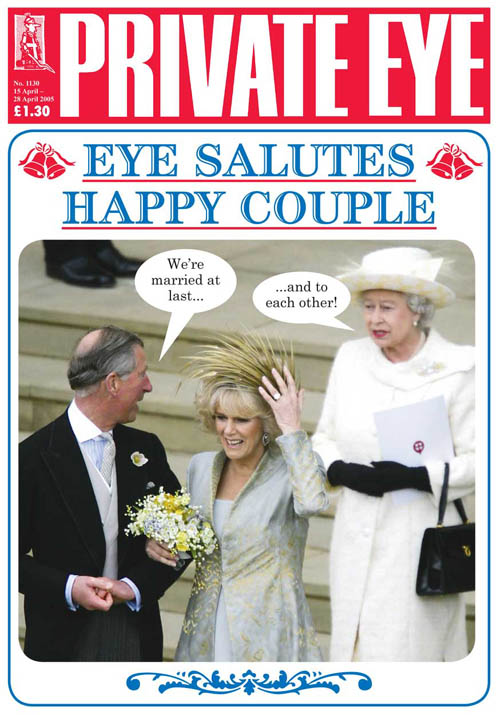
...The Private Eye


To preempt anyone from getting the impression that I really do read nothing but comics I'll tell you about the fortnightly rag which I've subscribed to for about five years now.

The Private Eye is a satirical and current affairs "magazine" (magazine to me means glossy paper as standard, and the Eye is printed on stock one level up from newsprint so I don't class it as a magazine really) started in 1961. The current editor is Ian Hislop (one of the regulars on Have I Got News For You) and it has a reputation for mixing bold investigative journalist with immature humour. It's also always in the courts being sued over some story or another.

I began reading it during my debating phase in S2. Its style of humour appealed to me, since I was just getting into satire thanks to the gift of Dead Ringers cassettes. It took me a while to pick up the running jokes; for instance, fake articles are generally said to be "continued on page 94" (which doesn't exist, it's just an easy way of killing it once the satirical point has been made), and when I first read that I did look for page 94 only to be very confused. Also, every recurring company or person earns themself a nickname, most of them unpublishable in any other serious paper.


I learnt a lot of what I know about politics from the Eye, since what it excels at is drawing connections between events: an MP who behaves in a certain way may be anticipating a job on a related company's board, or their spouse might have a vested interest. The overall pattern which builds up is a mixture of sinister, self-serving inside dealing and pathetic incompetence.

My favourite parts are when there is an extended investigation into a specific topic, usually once a year or so. Once it was the £12bn NHS IT fiasco, another it was a thorough review of the Deep Cut case and the cover-up afterwards. There was also a brilliant article examining the Lockerbie Bomber story, printing information which I've never seen or heard from a mainstream news source, but which paints a radically different picture of the case. It's available to download here and is well worth a look (£5, or free for subscribers).

Next week: ...probably comics :P

Thursday, 15 October 2009

Dr Horrible's Sing-Along Blog (2008)


In our Introduction to Cinema class yesterday, we touched on the relationship between TV and internet, and it made me think about this, to me the most successful fusion of the two. And it's not surprising that it works, it's made by Joss Whedon.

It's a three act story, released over several days online. It's available to buy on iTunes, and it even got a DVD release. Without Joss's name and loyal-bordering-on-obsessive fanbase, a 45 minute internet series would never gave gained as much attention as it did, and it also wouldn't have attracted stars like Neil Patrick Harris, Nathan Fillion and Felicia Day.

I'm almost incapable to describing everything that's brilliant about this because I love it so much, but I'll try.

First off, the songs. In my last post I said how much I hated musicals, well this is an exception. The songs are witty and honest, with clever rhymes and beautiful harmonies. "I cannot believe my eyes" is a brilliant song, which forwards the plot and explores character motivation; "Laundry" is one of the most truthful descriptions of falling in love I've heard; "Bad horse" will stick in your head like Sticky the sticky stick-insect; "I won't feel" is perfectly tragic. It helps that the cast are all excellent singers.

The characters are instantly lovable - so important given that we only have 45 minutes to get to know them. Billy, aka "Dr Horrible", is lovably inept, and it's refreshing to have the Baddie be the hero for a change. Penny, his unattainable object of affection, is sweet and good-natured yet hopelessly unaware of others' true characters. Captain Hammer is hilariously macho, and a better representation of what a superpowered dude would be like than an angsty Clark Kent - he's basically just a big bully.

As always, Joss's trick is to make the audience empathise and care about these characters so that every event in the brief plot is an emotional hit.

The afterlife for this series is unique, in that it has gained in popularity thanks to word-of-mouth (or, more likely, messageboard) and has spawned more creative spinoffs.

The DVD has the best commentary of any tv show or film ever in the history of DVDs. I won't be moved on this. The commentary is sung. They wrote and recorded songs, making the actors and writers into characters as much as Billy and Penny. Some of those are even better than the musical's songs, my favourite being "Pick it apart", Joss's lament about being constantly questioned about his work. I've probably listened to the commentary more than the series itself, to be honest.


Dr Horrible also made a Horrible appearance in the Emmy awards, (where it was criminally passed over I might add):


So, go out and watch it, it'll only take 45 minutes and you'll be a convert by the time Moist appears. I promise.

Act 1 / Act 2 / Act 3

The Wizard of Oz (1939)


I'm not a huge fan of musicals. With a few exceptions, I'd rather watch a film in which the plot is forwarded through action and where emotion is expressed by acting; the few musicals I love I tend to skip the singing bits, with Singing in the Rain and Enchanted pretty much the only ones I watch uninterrupted. It's probably no coincidence that both have a slightly post-modern approach to the musical.

The Wizard of Oz is not one of those exceptions. Every time they burst into song I mentally go into sleep-mode, just waiting for the action to start up again.

But that's just a personal prejudice, most people love musicals. They're opera for the modern age. I do like this film, even if mostly it's because of nostalgia rather than merit. It's a film I've watched with family at Christmas, and which has been parodied and referenced until it's simply a part of our cultural consciousness.

Watching it again, and in a formal setting, I was able to take a more objective view. And objectively? It's patchy.

On the bad side is the acting. It's overdone and stagey in the worst pattern of films of this era. There's also the horribly tedious pacing, which means we have to sit through endless sequences with the oompa-loompas or whatever it is they are, or the Lion's interminable song.

I do like the effects, I've had a great affection for miniature effects since my immersion in Classic Doctor Who (which you might have thought would have cured my impatience with pacing, what with 4 hour storylines) and the design overall is very imaginative. This would have been better if it hadn't been for the faulty projector, which washed out all the reds - important in a film where a plot point is a red pair of shoes.

My feelings about the ending are mixed, and I think it's very open to interpretation. My view is that it's a stinging critique of American society, but it's either incredibly subtle or just my own imagination, because most people see it as just a happy ending.To me, the fact that instead of courage the Tin Man is given a medal is meant to be an attack on the kinds of soldiers who never went to war but were decorated handsomely - something which would be alive in the memories of ordinary people only twenty years after the Great War. The Wizard, to me, is one of the most sinister characters - a deceiver as much as his real-world counterpart and far less likable than the amiably OTT Wicked Witch.

Wizard of Oz is undoubtedly a film you should watch, but I have grave doubts about its ideas and execution. Maybe next time I'll cue up Dark Side of the Moon and see if that agrees with me any more.

The Soloist (2009)


I got a very strong sense that I was being shown Joe Wright's shock at moving to LA watching this film. The deprivation of the city is not something I know very much about, since all I've seen has been part of the Hollywood machine - glossy, rich young people and their glossy, expensive cars. It was shocking to me to see the level of poverty some people live in and the way the homeless are treated by the authorities. America is so often presented as a utopia of liberty and opportunity, but we see a homeless man being arrested for illegal possession of a shopping cart.

The film as a whole develops a greater feeling of truthfulness from the casting of genuinely homeless people and the use of locations - it was filmed in an area with the highest concentration of homelessness in America.

The Soloist was also very brave in its depiction of mental illness. Nathaniel is shown to be incredibly talented, but we are not given an idealistic view - his schizophrenia is a barrier, preventing him from realising his full potential and sometimes making him dangerous. The scene where he turns on his friend and nearly kills him is terrifying and all too realistic.

One of the most interesting aspects for me was the glimpse it gave of synesthesia - a mental quirk which basically mixes your senses up. Nathaniel, in common with many musicians, experienced music as colour and we were shown this as a coloured lightshow as Beethoven was played. It was very well designed, somehow feeling fitting to the music, even if it hurt my eyes a little.

Jamie Foxx was fantastic, inhabiting his character brilliantly. It was a demanding role: he had to imitate a mental illness and look at home playing a violin and a cello, and he pulled it off. Robert Downey Jnr gave a very Robert Downey Jnr performance - it was no great transformative leap, but he has a compelling screen presence and can get away with that.

The timing of the release is interesting, since we're nowhere near awards season yet and this is a very strong contender for awards - it's a serious drama with talented, previously-nominated actors. I could easily see this being nominated for cast, director and cinematography and yet, I wonder if its chances will be affected by a long wait inbetween release and nominations. Possibly this was an economically motivated move - right now it has minimal competition, being put up against comedies, kids' films and horror flicks. I hope that pays off, since its an excellently well-made film with a worthy plot, and the idealist in me loves to see people making good films doing well.

Wednesday, 7 October 2009

creative beginnings

I'll admit that I went into Creative Beginnings with a fair amount of skepticism. It seemed to me like just another barrier to getting on with the course, which I've been looking forward to since I heard it existed 18 months ago (it's been a loooooong wait). I'm glad to say, however, that I was proved wrong.

Sure, some parts of it grated on me. I found it frustrating that in such a large group it was difficult to really engage with everyone on a personal level - I would have loved to have questioned some people more thoroughly - and with 25 people all voicing their opinions (or, in reality, more like 10) arguments tended to go round in circles. I would also question whether the central question matters - should we be thinking about who culture 'belongs' to or going out there and making it? That's just a reflection of my own opinion on the question, though, and I'm aware of its usefulness in making us question our ideas.

The first task was a bit of a poser. I toyed with how deep or how literal to make it, and ended up panicking one night before I moved and going and taking a pretty rubbish version:


After I'd moved, and once I'd calmed down, I decided to take a good picture this time, and enlisted the help of my comrade in arms Maisie Cottingham (BA TPA1 for those who don't know):


It's very important for me that she was in it, since I wouldn't actually be here, at the RSAMD, without her. It's thanks to her that I came to an open day and fell in love with this crazy place and found this course, which seemed to fulfil every criterion I could have hoped for. I also surrounded myself with all the things which have gone into forming my creative consciousness: my novels, my magazines, my comics, my plays (a lot of plays), my films, my tv series. Also, I wanted something to represent me, so I threw in my camera (you can just see it in the background), my dear Macbook, my new shoes and my badass bikerboots. And, as the final layer of pretentiousness, I sat there reading Voltaire.

In the session, it was fascinating to see how others had interpreted the task. Some had taken it completely literally, and it was great to see the wide variety of beautiful places people have come from - I do think the diversity of the RSAMD's students is one of its strengths, and I'm glad to be a part of that. (Oh God, I'm starting to sound like an Equality and Diversity lecture!) I also loved the more metaphorical interpretations.

From the first day, what I really took was that everyone had a very different idea of what they were getting into. We couldn't agree - not in a confrontational way, we just couldn't reach a consensus. And that didn't change, and I'm not sure I'd want it to. It's good that everyone thinks something different! My personal take on "culture" was a very thorough, though probably not quite thorough enough, definition:

Culture is an accumulation of creative ideas, incorporating ritual and ceremony and the social, political and personal landscape. It is a constantly evolving influencing force.

And as for who it belongs to, I would say: no one. I don't believe culture can be owned, only added to. I liked another group's use of a metaphor:


Culture is like soup: you've got your dance, your drama, your art, your music, your everything basically, thrown in there, and we should be like delicious croutons floating on top. You don't want to sink to the bottom, just float on the top deliciously. And everyone can have a bowl, and they can all have whatever they want from this soup. And the RSAMD in this metaphor is either the soup pot or the chef ... it's hard to say ...


An interesting look at it, plus, who can resist a soup metaphor?

We also looked at Scottish culture in the specific, which is an interesting area for me.

Though I've lived here for a long time - longer than anywhere else - I am by no means Scottish. I'm an outsider, and one who has had the opportunity to observe scottish culture in great depth. I think it has a wonderful tradition of education, one which people who have lived here all their lived probably don't appreciate. The schools here are better than anywhere else in the country, some of the best in the world, and you only have to look at the way further education is funded to see that. I also love the culture of creativity - there is a greater willingness to express oneself in Scotland than the rest of the uk, especially England. People are more gregarious, and friendlier. I've not encountered a Big Issue seller who proposes marriage to the pretty girls who walk past anywhere except Glasgow. There's also the more negative side - the fighting culture, the drinking culture, the unhealthy food. None of these are universal, and yet they create an overall pattern to me of what living in Scotland is. And that is why I love it here, and am happy to stay here for the rest of my education.

On the second day, I got to indulge my love of drama games! Say what you like, they're fun and they wake you up.

It also gave me more of an opportunity to meet and work with people from other disciplines; one of the most attractive elements of the Academy for me is that you work so closely with actors/technicians/dancers on a daily basis, and it was a great chance to actually get to know them a little. I tried to give a good first impression - not hard when the method of introduction is giving them a hug - and find out a little bit about them. What emerged from this day was that we freshers have a lot in common. We expect similar things from our 1/3/4 years here - hard work, collaboration, support - with just a little variation for course-specific things. I was glad that in these exercises people seemed to be being open and honest - I certainly tried to open up and participate.

We had to bring in a statement, saying what we would bring to the course, and an object to represent ourselves. My statement, in rather pretentious language, I'm sorry, ran thusly:

I bring all that I have, which is all that I am.

What can I say, I love verbal symmetry. I was raised with Shakespeare from an early age.


My object was a pen. Yeah, looks like I grabbed the first thing my hand fell on in the morning, doesn't it? Well, I didn't really have the range of choice I would have had at home (my real home that is, although Glasgow is coming to mean home more and more) but I chose it for several reasons. I always need a pen, for writing down ideas and impressions, or sketching in my patented "can't actually draw" style. Also, and here comes the metaphysical bit, I want to make my mark on the RSAMD. See what I did there? Do you?

In the afternoon, we split into groups and were sent into the city like the Israelites into the desert (wow, I've been writing for a long time now, you can tell because I just made a Biblical allusion) to wander until we found a place which represented the culture we were going into. My group consisted of two MA students (Classical and Contemporary Text and Musical Theatre) and a TPA student, stage management and production strand. We debated several places, trying to think beyond the obvious and, basically, out-do the others. Competitiveness is the fuel for creativity! Eventually, we reached Central Station (which a stubborn part of me always calls "Grand Central Station" for some unfathomable reason) and found our way to the "Harry Potter Platform" - Platform 12, nee 11a, right at the end where all the train-spotters lurk. We edged past them and took our photos just past the DO NOT CROSS THIS POINT point, with a backdrop of signs and signals. We chose it because it shows the industrial, practical heart of Glasgow rather than the shortbread tin version, and the metaphors for the choice we have to take and the paths we'll travel fall into your lap.

I would have preferred to have used a better camera than the one in one of my colleague's phone, and to have developed it onto proper paper, but we weren't given any warning so there's not much we could have done. Unless this is their way of saying to always have a camera with me...

Other's choices were intriguing - I liked the humourous use of traffic cones, and the derring-do of all those who tried to find a theatre which would let them in. I loved the pictures taken from some of Glasgow's vantage points - it really does have a beautiful skyline.

Today, the final day, we convened in the Chandler Studio Theatre under some atmospheric lights and I got to indulge my love of drama games again. Once we were warmed up, the srs bsns began.

Our installation was to pin up on one side of the room the picture representing where we came from, and what developed from that was a picture of just how diverse our backgrounds were, from rural areas to foreign cities. Some people emphasised that they come from travel, which  I could sympathise with.

We then wrote four things on the floor in chalk:

What we bring to the academy
An anxiety we have
A hope we have, and
A question we had.

Mine were:

I bring everything!
I fear failure
I hope that ^ won't stop me from trying
When do we start?

As time went by, it became scuffed and blurred, but it was beautiful to me to see what people had written. Some had gone for humour, (one question was "where is Hugh Hogart's office?" and one fear was "swine flu"), some for impact (you all saw the foot-tall lettered one) and some seemed perfectly confident ("fearless"). What warmed me were all those who expressed the doubt they still felt about themselves; "they'll find out that I'm actually shit", "what will happen if I fail?", "am I good enough?", and all of those who wrote "failure" as their fear. I can sympathise with that lingering doubt that they aren't up to it, for all that I know it's an insecurity based on fear rather than a recognition of fact.

The most upsetting was "I am where I wanted to be. Or so I thought." I hope that they feel differently once work begins in earnest.

Finally, we wrote a letter to ourselves on graduation. I wrote some personal things, about where I am where I hope to be. Who I hope to be. I also betrayed my bossiness and gave myself some orders, particularly about who I should go and hug. Oh, and I drew a picture. Why not? This exercise was incredibly moving to me, since I can see myself opening this letter and thinking back to this time when I was just starting out. It feels like insurance for the future, and I can start by taking my own advise now. I wish we'd done this kind of thing in highschool, it would have been lovely and it would have made our eventual departures that bit more meaningful.

I hope we'll get to see the picture of us all on the steps, scaring the gentle folk of Glasgow with our rowdy drama-school-ness. It would show such hope, and commemorate what, for me, has been an eye-opening few days. I learnt a lot about the other people I will work with, about myself and it made me think about what I actually want to achieve. By setting it down, I feel like I'm more likely to act upon it. The same goes for my anxieties - looking at them, and looking at other people who feel the same way, makes me feel better about them. I know that they're there, but I know not to worry.

I'm very excited for what comes next! I feel prepared, and as keen to get going as a horse that's been questioned about culture for three days when all it wants is to go and gallop.

So well done if you've read through all that, I can talk about myself at great length, although I'll stop now since my stomach is making awful noises at me and is threatening to revolt.

Surrogates (2009)

In a modern age of mobiles and computers which can control our lives remotely, how does a filmmaker create tension? As was proved only too clearly by the film I saw last night (Surrogates) it's very difficult to make an audience member's palms sweat by typing a number into a box.

In Surrogates, a billion people are about to die! How could it get more threatening than that, right? Trouble is, we don't really feel engaged with that threat because we don't see anyone dangling over the edge of a cliff or a train thundering towards where they're tied to the tracks; all we see is a little computer scree not unlike the one we look at every day at work. Sure, it makes sense it the context of the film for that outcome, but it doesn't work on the emotions.

Partially, that could just be the fault of a overall weak narrative - a billion people under threat is such a large number it begins to lose meaning - but I do still feel that this is a problem in any film which tries to incorporate technology into its suspense.

Many action-adventure films solve the problem with a historical or fantasy setting. Pirates of Caribbean, has the best of both worlds with no technology, only mystical artefacts and pure physical threat. When we can see the pain, and most importantly the anxiety on the character/s' face/s*, we can begin to sympathise and engage with the threat.

To create the same effect in a modern-day or future-set story, what would have to happen? I can't see any way to make it work with the action involving any variation on pressing a button - there needs to be authentic action by characters engaging with each other and a physical threat. The removal of all technology would be a very interesting approach - how long could you cope without your mobile? And on top of that, you're being chased by evil robots! Blockbuster right there. In the context of Surrogates, where technology is the crux of the story, it would have been more effective if our plucky hero had had to run down to the server and start ripping up cables, rather than just standing and delivering.

*there is a theory based on study of the way people's brains work that we naturally imitate the expressions and emotions we see on others, including films. This makes sense, since that is the process by which humans first learn expressions, and this carries on to learn empathy and sympathy, and is a trick which has been exploited by performers and storytellers since performance and storytelling began.

Saturday, 3 October 2009

Ahoy, avast, other miscellaneous sea-related cliches

Our first film screening was for The Poseidon Adventure during the induction days. It definitely falls into the category of films I would only enjoy watching in company both because of the scary elements (a childhood of family sailing holidays has taught me only too well how frightening boats can be when they're perfectly functional, let alone inverted) and because it's just a little to cheesy to take seriously.

The frights are achieved very simply by suspense, and damn good suspense at that. In contrast to the remake, a sense of doom is created from the very beginning as we learn that the sinister big business in charge is running the Poseidon unsafely. This build-up continues with the escalating news of an earthquake nearby and the possibility this will create a wave, shown in counterpoint to the essential Character Introductions and Humanisations, which are themselves quick and effective. For instance, we learn that Scott is clearly a Good Guy because he's nice to the waiters - an excellent substitute for rescuing a cat from a tree when there are no cats or trees handy. All this means that when the wave does hit, the audience is already in a state of tension.

This only slightly ruined by the alienating effect of seeing Leslie Neilson playing the captain - I more than a little expected him to say "don't call me Shirley" but that's the cannibalistic nature of parodies for you.

The characters were generally very well done, with a fantastic cast all in all. Gene Hackman just has what it takes to grab your attention onscreen and hang onto it, and his character was especially interesting since it seemed subversive to have such an unconventional hero: a minister who didn't want God's help. The others were mostly sympathetic - the lovely grandparents, the kind middle-aged man, the fiery dame, the grizzled ex-cop, the sweet teenager - with two big exceptions for the annoying 10 year old (TM) and the utterly useless weeping damsel. So many opportunites to drown such an annoying character, and yet - ! All wasted.

Overall, I enjoyed The Poseidon Adventure for what it was - a well told suspense/action/adventure story. It fitted its running time snugly and made allusions to loftier themes (faith, sacrifice, self-sufficiency, and of course, human relationships).

Poseidon, on the other hand, is offensively bad. The biggest thing I took away from it is that sometimes, to survive, you have to kick people in the face. Which would be an interesting moral dilemma - what is more important, personal survival or personal integrity? - except that the narrative then skips blithely onto the next laws-of-physics defying set-piece. While CGI may be better, the story just doesn't do its job to make you care.

Finally a technical note which, for the well informed, is a serious flaw. My sister is an architect and she watched the remake with me and winced the whole way through. She could just about accept the characterisations but two elements just don't add up:
  • if the ship was properly ballasted, there would be no danger of inversion occuring; this isn't a problem in the original since it's explained away but there's no mention of anything intially unsafe about the Poseidon in Poseidon
  • in both films, characters walk about on the ceilings as if they were floors - this simply would not happen; there needs to be space for services (such as electricity and water) and this would be in the ceiling space, covered by a thin layer which would collapse if walked on. Realistically, then, the characters should have been stomping through ceiling tiles like walking in snow. 
This is evidence that everyone reads films differently (not knowing about architectural structures the second point didn't even occur to me) and that you should always get an engineer to proofread your script.

Monday, 1 December 2008

Filming begun

Last Wednesday we began filming, getting the majority of scene 2 in the bag (I suppose I should really either say "in the can" or "in the... cassette case..."). Yet again, I took over the isolation room and moved all the jolly paintings out. Hopefully the graffiti from previous occupants won't show up. We learnt a lot, including that Sean gets a bit of a Hitler moustache in some lights and that the room we're filming in gets REALLY hot. That's impressive, since the rest of our school is virtually unheated. Now we know where it all goes.

We also did some filming on Thursday, actually during school. It turns out that this isn't exactly the best time, and a lot of really good takes - acting-wise - are completely useless because over Sean being all serious and sinister, you can hear S4s signing out after their french prelim. What a mood-killer. The worst was a very loud man with a deep monotone. Urgh. We did get one really good take though and the planimetric shot works really well.

Alongside all this serious filmy stuff, we're planning the DVD extras and I think they're gonna be FUN. We have a range of impressions, out-takes and a whole sequence of Sean's interaction with my mic ferret. Very odd. I think we'll probably do a commentary as well, but that'll have to wait until much later.

Over the weekend I did a rough cut-up of the first five minutes; it still needs a great deal of finessing, but I think it's looking great. There are several elements missing (the sound of Holly being dragged, shots of her previous interviews and an overall deeper sound design; I also just put the name "Betty Bettyson" in as a placeholder because we haven't held auditions for the part of Darya yet).

On that subject, I decided to cast someone else as Darya after a long and detailed consultation... OK, so the three of us were on the bus to PYT and we had a chat. Basically, it's a film and we can have someone else and it makes sense to. I'm going to talk to the Highers tomorrow and gauge their responses. With any luck I'll audition on Wednesday and have reached a decision by Thursday.

One thing's for sure - if I want this filmed by Christmas, we'll need to step on it.